
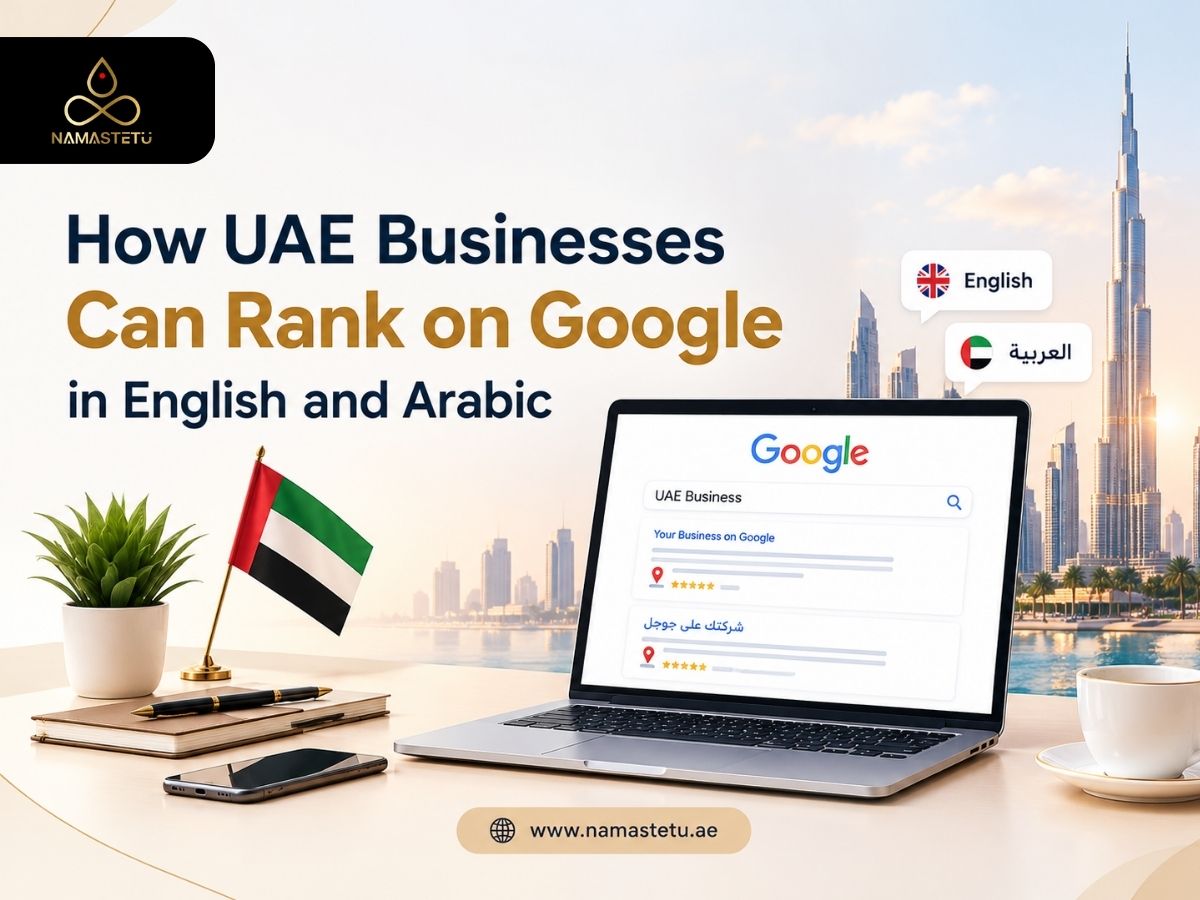
To rank on Google in both English and Arabic, a UAE business needs separate, properly built pages for each language, keyword research done natively in each language, and clear technical signals that tell Google which page belongs to which audience. That is the heart of bilingual SEO in UAE: two search-ready experiences living on one website, not one page run through a translation tool. Get these three things right and your business can show up for the expat in Business Bay and the Emirati family in Al Ain, each searching in their own language.
Why Ranking in Two Languages Matters in the UAE
The UAE is one of the few markets where a single city holds people from almost every country on earth. English works as the common business language, yet Arabic is the official language and the one many locals, government users, and regional buyers naturally search in.
If your website only speaks English, you are invisible to a large group of ready-to-buy customers. If it only speaks Arabic, you lose the international crowd. Most of your competitors still pick one side, which means the gap is open for you.
Here is what a bilingual presence gives you:
- Wider reach: You appear in two sets of search results instead of one.
- Higher trust: People feel more comfortable buying from a business that speaks their language.
- Less competition: Arabic search results are often thinner than English ones, so ranking can be faster.
- Better fit for AI answers: Answer engines pull from clear, well-structured pages in the language the user asked in.
What Bilingual SEO Really Means (and What It Does Not)
Many business owners think the job is done once the site has a language switcher. It is not.
Google treats an Arabic page and an English page as two different pages that must each earn their own ranking. Each one needs its own keywords, its own title and description, its own headings, and its own internal links.
Bilingual SEO is not:
- Pasting text into a free translation tool and publishing it
- Using one page with both languages mixed together
- Hiding the Arabic version behind a script that search engines cannot read
Bilingual SEO is:
- Writing each page for the people who will read it
- Researching how real people search in each language
- Telling Google exactly how the two versions connect
This is also why a proper bilingual SEO strategy for UAE businesses starts with planning, not publishing. You decide which pages need both languages, which can stay in one, and how each language will bring in customers.
Step 1: Start With Arabic Keyword Research, Not Translation
This is where most websites go wrong. A keyword that works in English rarely maps neatly to Arabic.
Take a simple example. An English user might type “dentist near me.” An Arabic user might type a word for dentist, a word for clinic, or a mix, and may use Gulf Arabic wording that differs from formal Arabic. Direct translation misses all of that.
Good Arabic keyword research looks at:
- Dialect: Gulf Arabic phrasing often differs from the formal Arabic found in textbooks.
- Spelling variants: Arabic words can be written in more than one way, and people search all of them.
- Arabizi and mixed searches: Some users type Arabic words in English letters, or mix both languages in one search.
- Intent: Is the person looking for information, comparing options, or ready to call?
A native Arabic speaker who understands search should lead this work. Tools can show volume, but only a human can tell you which phrase sounds natural to a customer in Sharjah.
Once you have a keyword list for each language, map one main keyword to one page. Do not let two pages fight over the same phrase.
Step 2: Build the Right Site Structure
Your site structure tells Google how your languages are organised. There are three common ways to do it.
| Setup | Example | Best For | Main Drawback |
| Subfolders | yoursite.ae/ar/ | Most UAE businesses | Needs clean technical setup |
| Subdomains | ar.yoursite.ae | Large sites with separate teams | Authority can be split |
| Separate domains | Two different domains | Rare, very large brands | Costly to build and maintain |
For most small and mid-sized companies, subfolders are the simplest and strongest choice. All your ranking power stays under one domain, and both languages help each other grow.
Whichever you choose, stay consistent. Switching structure later can cause ranking drops that take months to repair.
Step 3: Tell Google Which Page Is Which With Hreflang
Hreflang is a small piece of code that tells Google, “This page is the Arabic version of that English page.” Without it, Google may show the wrong language to the wrong user, or treat your pages as duplicates.
Keep these rules in mind:
- Every English page that has an Arabic twin should point to it, and the Arabic page should point back.
- Each page should also point to itself.
- Use the correct language and country codes for the UAE.
- Add a default version for users whose language does not match either one.
Mistakes here are common and often invisible. A technical review will catch them. If you want a second pair of eyes, our technical SEO service checks hreflang, indexing, and site speed in one pass.
Step 4: Get the Arabic Layout and Design Right
Arabic reads from right to left, and your design has to respect that. A page that looks fine in English can feel broken in Arabic if the layout is only mirrored halfway.
Check these basics for strong English and Arabic website optimization:
- Right-to-left direction: Text, menus, buttons, and forms should all flow correctly.
- Readable Arabic fonts: Pick a font built for Arabic, not a fallback that looks cramped.
- Mobile first: Most UAE searches happen on phones, so test both versions on small screens.
- Fast loading: Heavy fonts and images slow both versions down and hurt rankings.
- Matching content: If the English page has a pricing section or a FAQ, the Arabic page should too.
A clean build matters more than most people expect. If your site needs a rebuild to support both languages, a good website development company in Dubai can set up the right-to-left structure from day one instead of patching it later.
Step 5: Write Content That Sounds Local in Both Languages
Google’s helpful content system rewards pages that clearly help real people. In two languages, that means two pieces of writing that each feel native.
Follow these habits:
- Write the Arabic page from the same idea as the English one, but let the wording change where it needs to.
- Use local examples, such as references to Dubai, Abu Dhabi, or Sharjah, in both versions.
- Show real experience. Add case details, team credentials, and customer stories to build E-E-A-T.
- Answer the question in the first few lines of each page. Search engines and answer engines both favour direct answers.
- Keep sentences short and clear.
If you cannot hire a native writer for every page, start with your highest-value pages: your home page, your top services, and your contact page. Grow from there.
Step 6: Win Local Searches in Arabic
Many buyers in the UAE search with a place in mind, such as a clinic in Jumeirah or a law firm near DIFC. Searching in Arabic works the same way, and it is where Arabic local SEO in UAE can give you a real edge.
To improve it:
- Set up your Google Business Profile in both languages. Add your business name, description, and services in English and Arabic.
- Keep your name, address, and phone number identical everywhere. Small differences confuse search engines.
- Collect reviews in both languages. Reviews written in Arabic send a strong local signal to Arabic searchers.
- Add area names in Arabic on your location pages.
The same fundamentals that help you in English apply here too. Our guide on local SEO fixes for Google’s AI search walks through the profile, review, and citation basics that carry over into the Arabic side of your strategy.
Step 7: Prepare for Answer Engines and AI Search
People now ask AI tools direct questions and expect one clear answer. These tools lean on pages that are well organised, honest, and easy to quote.
You can help by:
- Putting a short, direct answer at the top of every page
- Using clear headings that match real questions
- Adding a FAQ section in both languages
- Using structured data so machines understand your business, your services, and your language versions
- Keeping your facts consistent across your site and your profiles
This work sits close to what our team does with AEO services in Dubai, where the goal is to make each page the easy answer a search engine wants to share.
English vs Arabic SEO: A Quick Comparison
The two languages share the same goal, but they ask for slightly different work. This table shows where they overlap and where they split.
| Factor | English SEO | Arabic SEO |
| Keyword research | Large tools data, easy to compare | Needs native review for dialect and spelling |
| Competition | Often high in popular topics | Often lower, with more open gaps |
| Page direction | Left to right | Right to left |
| Search style | Short, direct phrases | Mix of formal, Gulf, and mixed-language searches |
| Content tone | Professional, concise | Respectful, natural, locally aware |
| Local signals | English reviews and listings | Arabic reviews, Arabic listings, Arabic area names |
| Technical needs | Standard setup | RTL layout, hreflang, Arabic fonts |
| Best first step | Clean on-page basics | Native keyword research |
Treat them as partners, not rivals. The strongest sites invest in both and let each language feed the other.
Who Should Handle This Work?
Some businesses try to manage both languages in-house. That can work when you have a native Arabic writer, an SEO lead, and a developer who understand each other. Many teams find it easier to bring in outside help.
If you are comparing providers, look for these signs:
- They can show Arabic work, not just English case studies.
- They use native speakers for research and writing.
- They explain hreflang, site structure, and local signals in plain words.
- They report on both languages separately, so you can see what is working.
At Namastetu Technologies, we treat English and Arabic as two parts of one growth plan. That plan can sit inside a broader Digital Marketing Service in Dubai that also covers content, local listings, and paid campaigns when you need quick traffic while SEO builds.
If you want more detail on how the English side fits in, our overview of SEO Service in Dubai covers audits, on-page work, and link building, and our Digital Marketing Service in Dubai page shows how those pieces connect with ads and social.
Common Mistakes to Avoid
Even strong teams slip on a few of these. Watch for them:
- Auto-translated pages: They read poorly and rarely rank.
- One URL for both languages: Google cannot index two languages from one address.
- Missing hreflang: Wrong-language results and duplicate issues follow.
- Ignoring Arabic reviews: Reviews shape local trust.
- Skipping mobile tests: Arabic layouts break easily on small screens.
- Forgetting to measure each language: Track traffic and leads by language, or you will not know where to improve.
A Simple Action Plan to Start This Month
You do not need to fix everything at once. Work through this order:
- Audit your current site. Check what exists in each language and what is missing.
- Run keyword research in both languages. Map one keyword to one page.
- Pick your structure. Subfolders suit most businesses.
- Fix the technical basics. Set up hreflang, right-to-left layout, and fast loading.
- Rewrite your top pages. Start with your home page and main services.
- Update your business profile. Add Arabic details and ask for Arabic reviews.
- Track results by language. Review every month and adjust.
Steady progress beats a rushed launch. Most sites start to see movement within a few months when the foundations are right.
Frequently Asked Questions
1. How do I rank a UAE business website on Google in English and Arabic?
Create a separate, well-written page for each language, research keywords natively in both, and connect the pages with hreflang tags. Use a clear site structure, such as subfolders, and make sure each page has its own title, description, and headings. Then build local signals like reviews and business listings in both languages.
2. How can I improve Arabic and English SEO for businesses in Dubai?
Start with an audit of what each language version already does well. Fix technical issues, improve page speed, and rewrite weak pages with native speakers. Add a Google Business Profile in both languages and collect reviews from customers who speak each one. Track both languages separately so you know where to focus next.
3. What are the best bilingual SEO strategies for businesses in the UAE?
The best approach combines native keyword research, a clean site structure, correct hreflang setup, and high-quality writing in each language. Add local SEO in both languages and a FAQ section on key pages so search and answer engines can quote you. Measure each language on its own.
4. How do I target Arabic and English keywords on the same website?
Give every keyword its own page and its own language version. Keep English and Arabic on separate URLs, such as /ar/ for Arabic, and link them with hreflang. Never mix both languages in one block of text, and never use one page to chase two languages.
5. How can UAE companies attract Arabic and English speaking customers through SEO?
Publish helpful content in both languages, use phrases each group actually searches, and show up in local results with accurate profiles and reviews. Make sure your website feels natural and fast in both layouts. Over time, both groups find you through their own search habits.
6. Is Arabic SEO different from English SEO?
Yes. Arabic SEO adds right-to-left design, dialect-aware keyword research, spelling variants, and Arabic local signals. The goals are the same, but the work behind each language is different.
7. Can I use translation tools for my Arabic pages?
Translation tools can help with a first draft, but a native speaker should always review and rewrite the final text. Pages that read as machine-made rarely earn rankings or trust.
8. How long does bilingual SEO take to work?
Most websites start to see early movement within a few months, though results depend on competition, content quality, and technical health. Arabic pages in less crowded topics often move sooner.
Conclusion
Ranking in two languages is not about doing twice the work. It is about doing the right work twice: research each language properly, build a clean structure, write for real people, and give search engines clear signals.
The UAE rewards businesses that meet customers where they already are. The sooner your English and Arabic pages both work hard for you, the sooner you capture searches your competitors are still missing.